
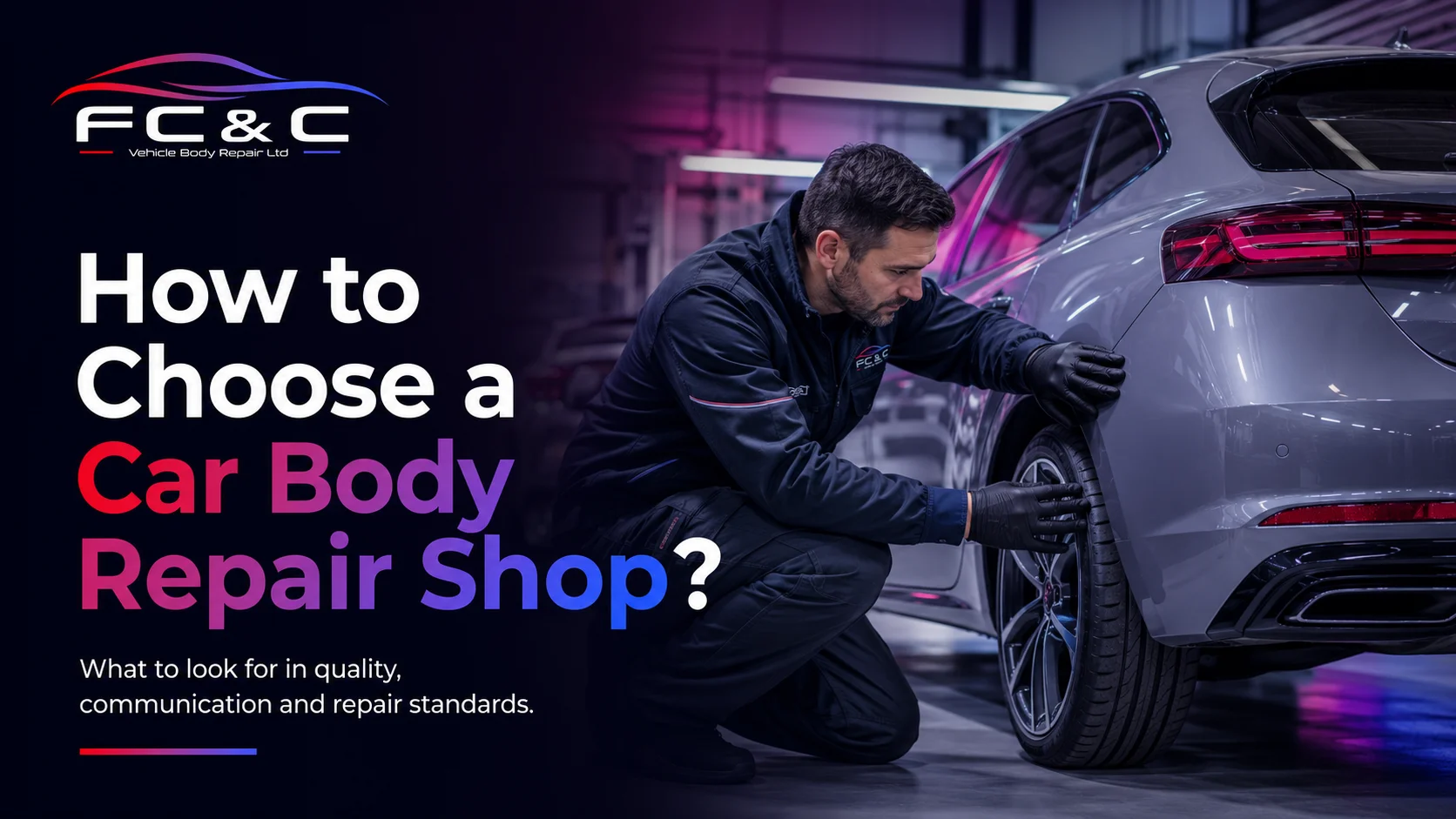
Choosing a car body repair shop can be difficult because almost every garage uses similar language. Search online and you will quickly find promises of experienced technicians, quality workmanship, excellent service and competitive prices. None of those claims tell you much about what will actually happen to your car.
A better way to choose a body shop is to look for evidence. Does the workshop regularly carry out the type of repair you need? Can it show examples of previous work? Does the person assessing the damage explain what needs to be done and why? These questions are much more useful than choosing solely on price or advertising.
Make sure the workshop specialises in the repair you need
Body repair is a broad field. A garage that is excellent at routine servicing and mechanical work does not automatically specialise in accident repair, paintwork or plastic repairs. At the same time, a business focused on small cosmetic jobs may not be the right choice for a vehicle with substantial collision damage.
Start by checking whether the workshop regularly carries out repairs similar to yours. For a damaged vehicle, this might mean dent removal, bumper repair, plastic welding, body panel repair, accident damage, paintwork, resprays or alloy wheel refurbishment.
Experience with a particular type of repair matters because the process, equipment and skills required can vary considerably depending on the damage.
Look at real examples of previous repairs
Photographs of completed work can tell you more about a body shop than generic claims on a website. Before-and-after examples show the type of damage the workshop deals with and give you an idea of the standard of the finished work.
When possible, pay attention to how repaired panels align with neighbouring bodywork and whether paintwork looks consistent across the vehicle. Customer reviews can also be useful, especially when people describe the specific repair they had carried out and their experience throughout the process.
A five-star rating is useful, but a detailed review explaining how a damaged door, bumper or wing was repaired provides much more information.
Ask what the workshop plans to do
You should not need to be a body repair expert to understand what is going to happen to your vehicle. A good workshop should be able to explain the repair in straightforward language.
If the bumper is cracked, ask whether it can be repaired or needs replacing. If a door has been dented, ask whether the original panel can be restored. If paintwork is required, find out whether only the damaged panel will be painted or whether blending into an adjacent panel may be needed.
The aim is not to challenge the technician’s knowledge. It is simply to understand what you are paying for.
This becomes particularly useful when comparing two quotations, because a lower price does not necessarily mean the same repair is being offered for less money. The scope of the work may be completely different.
Do not compare quotes based on price alone
Body repair involves a lot of work that is difficult to see once the car has been finished. Preparation, removal and refitting of parts, repair beneath the surface and the paint process all affect the final result.
A cheap repair can look acceptable when you collect the vehicle but become disappointing later if preparation was poor or corners were cut. Equally, a higher price does not automatically guarantee better work.
The important question is what is included.
If two body shops give significantly different estimates, ask each one to explain the repair process. This makes it much easier to understand whether you are genuinely comparing like with like.
Ask how paint will be matched
One of the clearest signs of a poor body repair is a panel that does not match the surrounding paintwork.
Although manufacturers use paint codes, the colour currently on a vehicle can vary slightly from the original factory specification. Age, sunlight, previous repairs and general wear can all affect the finish.
Metallic and pearl colours add further complexity because their appearance changes depending on light and viewing angle.
A professional body shop should therefore have a reliable approach to colour matching and refinishing rather than treating the paint code as the complete answer.
Consider the complexity of modern vehicles
Bodywork on a modern car is not always just bodywork. Parking sensors, cameras and driver assistance equipment can be positioned in or around bumpers and other exterior components.
More substantial accident damage can also affect mechanical or electrical systems that are not obvious from looking at the vehicle.
This makes proper assessment increasingly important. A repairer should consider not only how the damaged panel looks but also whether the impact may have affected equipment or components associated with that area of the car.
Good communication matters
The quality of the finished repair is obviously important, but the process matters too. You should know what is being repaired, what the estimate includes and what happens if additional damage is discovered after the job begins.
Hidden damage can occasionally become visible only after a bumper or panel has been removed. A good body shop should explain this possibility in advance and contact you if the scope or cost of the work changes.
You should not collect the car and discover that additional work was carried out without any conversation.
Choosing a body repair shop in Bristol
The best car body repair shop is not automatically the closest one, the cheapest one or the one with the biggest advert. Look for a workshop that understands the type of damage your vehicle has, can show evidence of previous work and is prepared to explain the repair before starting.
If you are looking for car body repair in Bristol, FC&C Body Repair can assess dents, scratches, bumper damage, paintwork and accident damage and explain the repair options available. You can send photographs for an initial assessment or arrange to bring the vehicle to the workshop for a closer inspection.
Call 07757 653888 or send us a message.
Check out our offer