

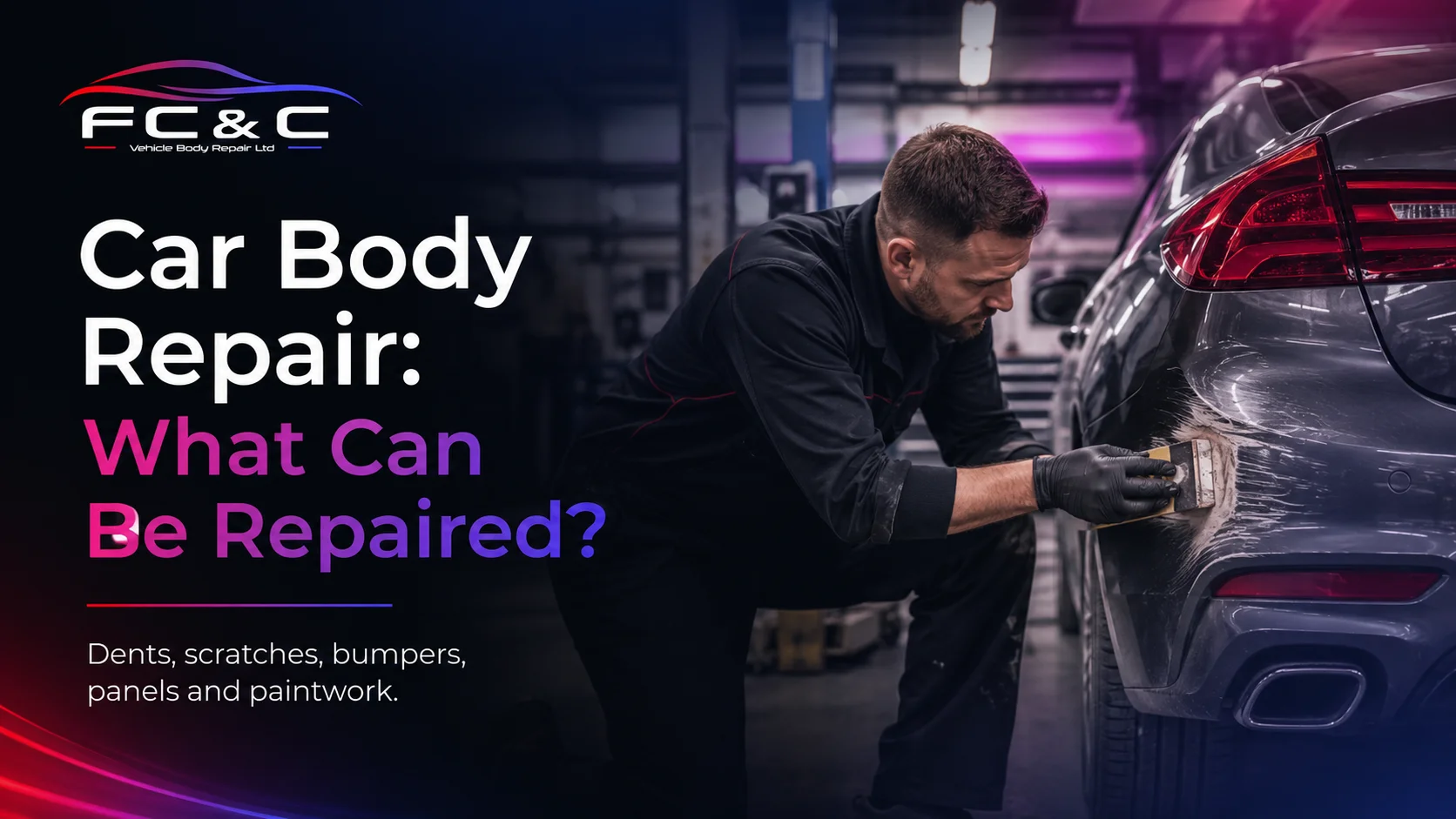
Damage to a car does not always mean that an entire panel needs to be replaced. Modern car body repair techniques allow many types of damage to be repaired effectively, from minor scratches and parking dents to cracked bumpers, damaged body panels and more extensive accident damage. The right solution depends on the location and severity of the damage, the condition of the affected part and, most importantly, whether it can be repaired safely.
At FC&C Body Repair in Bristol, we work with a wide range of bodywork damage, including dents, scratches, paint damage, cracked bumpers, damaged panels, alloy wheels and accident repairs. In many cases, the original part can be restored without the need for replacement.
Can dents in car bodywork be repaired?
Most dents can be repaired, although the method depends on their depth, shape and position. A small dent caused by another car door in a supermarket car park is very different from a deep impact across the edge of a wing or door.
If the paint has not been damaged and the metal has not been heavily stretched, the repair may be relatively straightforward. Larger dents or damage running through sharp body lines can require more extensive panel work before the surface is prepared and refinished. Even then, replacement is not always necessary. A professional assessment will usually determine whether repairing the original panel is practical or whether a new part would provide a better result.
What about scratches and paint damage?
The depth of the scratch is the most important factor. Light marks affecting only the upper layer of the finish can sometimes be removed or reduced with machine polishing. Deeper scratches that have gone through the clear coat and colour layer will usually require paint repair.
If a scratch exposes bare metal, it is worth dealing with it sooner rather than later. Apart from appearance, exposed metal can become vulnerable to corrosion. Two scratches can look very similar at first glance but require completely different approaches once they are inspected properly.
Can cracked bumpers be repaired?
Cracked and damaged plastic bumpers can often be repaired rather than replaced. Plastic welding and other specialist techniques can restore cracks, splits and localised damage before the bumper is prepared and repainted.
Whether repair makes sense depends on the extent of the damage and its location. A crack in the main surface of a bumper can be very different from damage to mounting points or areas surrounding parking sensors and cameras. After a stronger impact, it is also worth checking what has happened behind the visible bumper cover, as the external damage does not always show the full extent of the problem.
Can damaged doors, wings and other panels be repaired?
Doors, wings, quarter panels and other sections of bodywork are often repairable. The decision depends on how much the metal has been distorted, whether the panel has stretched, whether edges or mounting points have been affected and how much work would be required to return the panel to the correct shape.
There is no benefit in replacing a panel simply because it has a dent. Equally, there are situations where repairing badly damaged metal would take considerably more time and produce a less satisfactory result than fitting a replacement. A good body shop should be able to explain why it recommends one option over the other.
What happens with accident damage?
Accident repair can involve much more than improving the visible appearance of a vehicle. An impact may damage the bumper, wing or door that you can see, while also affecting components beneath the bodywork.
For this reason, the first stage should always be an assessment of the damage. Once the affected areas have been identified, the repairer can decide which parts can be restored and which, if any, need to be replaced. With more significant accident repairs, returning the vehicle to the correct condition is more important than simply making the damaged area look good from the outside.
Can faded or dull paint be restored?
Not every car with tired-looking paintwork needs a respray. Light scratches, oxidation and a dull finish can often be improved with machine polishing and paint correction, particularly when the original paint is still in good condition underneath.
If the clear coat is peeling, the colour has deteriorated badly or the damage extends deeper into the paint system, polishing alone will not solve the problem. In those cases, refinishing the affected panel or panels may be necessary.
Repair or replace?
There is no single rule that applies to every damaged car. Sometimes keeping and repairing the original part is the most sensible solution. In other situations, replacement is safer, faster or more economical.
The choice should be based on the actual condition of the vehicle rather than assumptions made from the appearance of the damage. If you are unsure, send FC&C Body Repair photographs of the affected area or visit our body shop in Bristol. We can assess the damage, explain the available options and recommend the repair that makes the most sense for your vehicle.
Call 07757 653888 or send us a message.
Check out our offer